
2115 Benchtop Test Analyzer

Designed for smaller test applications, easily fits in your fabrication or test department. The Model 2115 delivers powerful electrical testing in a compact platform built for benchtop and portable applications—with 1500 V isolation, 2 A continuity testing, and optional 1000 VAC breakdown testing.
Maximize Test Capability in a Compact Footprint
The Model 2115 delivers a compact, expandable wire harness testing platform designed for benchtop, portable, and space-conscious production environments without sacrificing high-voltage or continuity test capability.
The Model 2115 combines powerful electrical testing capability with a compact design suited for benchtop and portable applications. The system provides up to 1500 VDC isolation testing and a 2-amp continuity test stimulus while requiring minimal production space.
For applications requiring AC breakdown testing, an optional capability provides up to 1000 VAC, giving manufacturers the flexibility to address a broader range of electrical test requirements from the same platform.
Start With the Capacity You Need
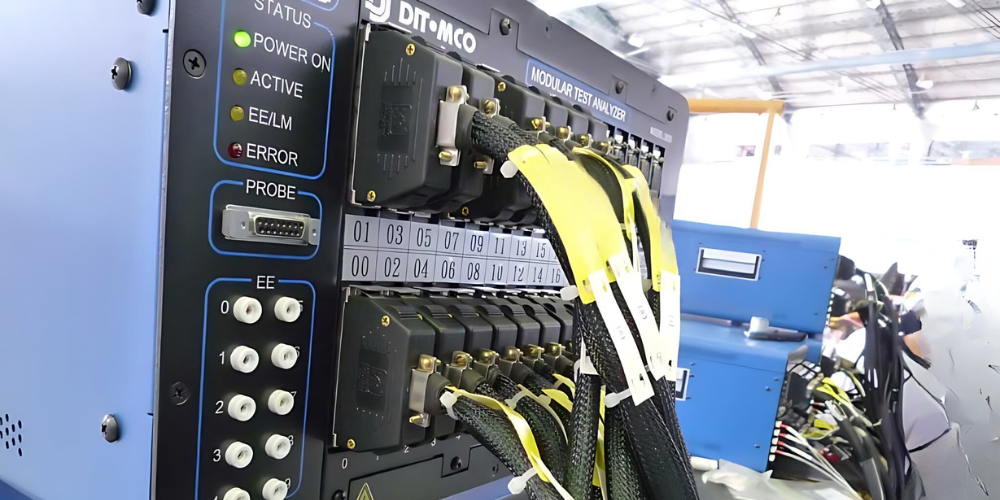
At the center of the Model 2115 is the Master Switching Unit (MSU), which combines control, instrumentation, and up to 1,000 test points of switching in a single chassis.
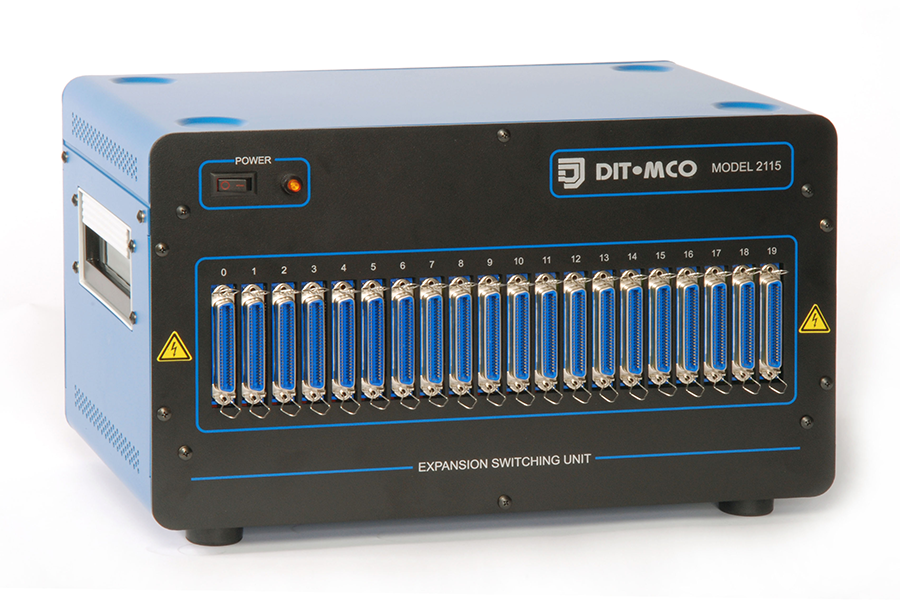
For applications requiring additional capacity, Expansion Switching Units (ESUs) can be added with up to 1,000 test points per unit. The system can expand to a total of 15,000 test points, allowing test capacity to grow as products and production requirements evolve.
For applications requiring AC breakdown testing, an optional capability provides up to 1000 VAC, giving manufacturers the flexibility to address a broader range of electrical test requirements from the same platform.
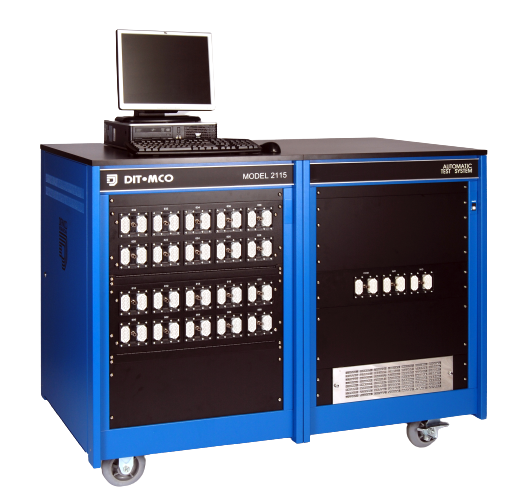
Configure Testing Around Your Production Environment
The compact Model 2115 is well suited for benchtop test stations, portable consoles, lean manufacturing cells, and other environments where floor space is limited.
Each MSU and ESU fits into a standard rack-mount enclosure. For larger systems, multiple chassis can be installed in a centralized cabinet to create a consolidated test interface while helping organize and protect the interconnect cables between system components.
Standard enclosure options are available, or the system can be customized to meet specific production, interface, and workspace requirements.
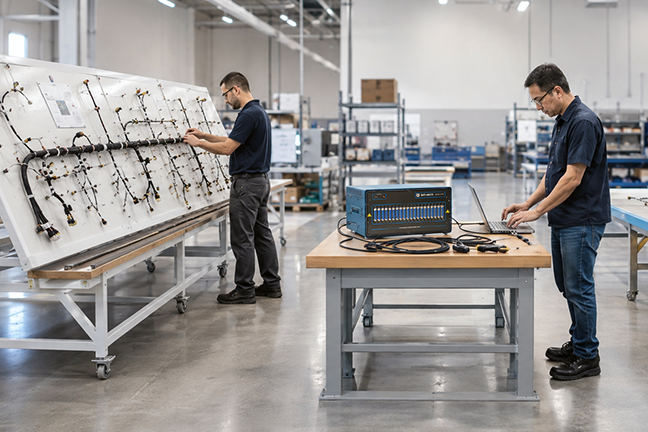
Expand Without Replacing Your Test Platform
The Model 2115 provides the flexibility to begin with a compact test configuration and expand as test requirements increase. Additional switching capacity, customized interfaces, and enclosure configurations can be incorporated into the system without requiring an entirely new test platform.
Whether used as a standalone benchtop analyzer or integrated into a larger automated test station, the Model 2115 can be configured around the needs of the application.
Additional Information and Specifications
The DIT-MCO Model 2115 Benchtop Wiring Analyzer is designed for automated testing of cables, wire harnesses, chassis, panels, and other wired assemblies. Its compact benchtop configuration combines high-voltage test capability, expandable switching, fast test speeds, and flexible instrumentation for production, test-department, and field applications.
The Model 2115 tests wiring and components for continuity, resistance, insulation leakage, voltage, capacitance, and dielectric breakdown. With test speeds of up to 5,000 tests per minute, the system helps identify wiring faults before they become costly assembly or in-service problems.
Expandable System Architecture
The Model 2115 is built around a Master Switching Unit (MSU) containing the system control, instrumentation, and switching electronics. The MSU supports up to 1,000 test points, with additional Expansion Switching Units (ESUs) allowing the system to expand to as many as 15,000 test points.
Both MSU and ESU units can be used in benchtop applications or integrated into standard rack-mount and larger cabinet configurations. DIT-MCO can also provide standard or application-specific interface connections.
Easy Test Programming
Windows®-based software provides menu-driven, point-and-click test programming. A self-programming function can generate a test program from a known-good assembly, helping reduce setup time. Software tools are also available to identify program issues before testing begins and provide detailed error reporting.
Available software capabilities and options include:
- TestLink®
- TestEdit®
- TestExecutive® with self-programming
- Write Error Program (WEP)
- Compensated Continuity Resistance (CCR)
- Syntax Checker (SYNCHK)
- Diagnostics
- TestAssistant® II
- APG/WIRESORT
- TestStats® Statistical Database
- Checksum (CHKSUM)
- Language translators
- Communications and networking
Hardware & Functional Test Options
The Model 2115 can be configured with additional hardware to support specialized applications, including:
- Continuity test probe
- Wireless remote control terminal
- Bar code reader
- Customer-specified connector interfaces
- AC dielectric withstand testing
- External power for component or relay energization
- Latching Matrix switching for functional testing
- External instrumentation access
A front-panel Continuity Test Probe connection can be used to verify loose wires or other test points that are not connected through the primary test interface.
For functional testing, optional Latching Matrix (LM) cards provide program-controlled relay switching and can be used to supply power to the Unit Under Test (UUT), interface with control or material-handling systems, or connect external instrumentation to the UUT.
Built for Reliability
The Model 2115 uses heavy-duty electromechanical switching and an industrial enclosure designed for demanding test environments. DIT-MCO switching relays are engineered to improve long-term performance and reduce relay-related maintenance.
Test & Switching Capacity
- Test Points: Up to 1,000 points in the Master Switching Unit
- Expandable Capacity: Up to 15,000 total test points
- Switching Increments: 50 points
- Expansion Capacity: Up to 1,000 points per enclosure
- Test Speed: Up to 5,000 tests per minute
- Switching: Heavy-duty electromechanical dual “Form C” relays
Standard Instrumentation
- Voltage Stimulus: Up to 1500 VDC
- Current Stimulus: Up to 2 A
- Continuity Resistance: 0.01 Ω to 99 kΩ
- Insulation Measurement: Up to 1 GΩ
- Four-Wire Resistance: 0.01 Ω to 10 Ω
- Capacitance Measurement: 10 pF to 5000 µF
- Continuity Accuracy: ±1%
- Insulation Accuracy: ±3%
- Instrument Configuration: Floating
Dielectric & Voltage Testing
- Simultaneous insulation and hipot testing
- DC Dielectric (Hipot) Current: 0.5 mA to 2.5 mA
- DC voltage measurement
- AC voltage measurement, true RMS
- Optional AC Dielectric Detector: 1000 VAC
Operating Conditions
- Operating Temperature: 60°F to 90°F (15°C to 32°C)
- Relative Humidity: 30% to 80%, non-condensing
- Application Environment: Indoor
- Input Power: 115 VAC, single-phase, 60 Hz ±10%, or 220–250 VAC, single-phase, 50 Hz
Master Switching Unit
- Dimensions: Approximately 23 in D × 19 in W × 12 in H
(58 cm × 48 cm × 29 cm) - Weight: Approximately 85 lb (39 kg), fully loaded with optional case
- Maximum Switching Capacity: 1,000 test points
Expansion Switching Unit
- Maximum Capacity: 1,000 test points
- Switching Cards: Up to 20
- Standard Dimensions: 11.13 in L × 19 in W × 11.48 in H
(28.3 cm × 48.3 cm × 29.2 cm) - Length with Custom Interface: 16.13 in (40.0 cm)
- Weight at 1,000 Test Points: Approximately 45 lb (21 kg)
Latching Matrix Ratings
- Maximum Switching Power: 1250 VA / 150 W
- Maximum Switching Voltage: 250 VAC / 125 VDC
- Maximum Switching Current: 3 A
- Relays per LM Card: 10 Form “C” relays
- Optional fixed and programmable power supplies are available for external energization applications.
Computer Requirements
Compatible with an industry-standard Microsoft® Windows computer, including:
- Laptop
- Industrial computer
- Customer-specified computer configuration

MBA (Multiple Bus Architecture) – Explained
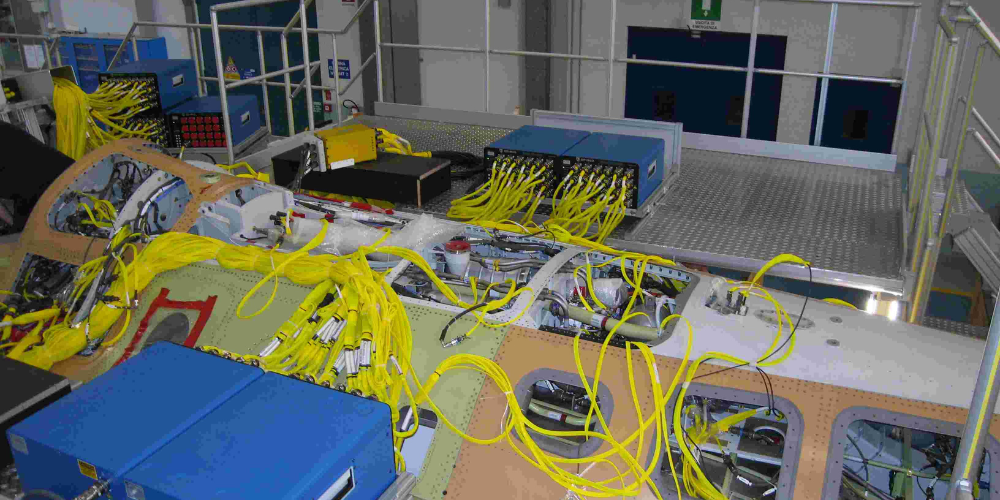
Application Purposed Cable & Harness Testing